
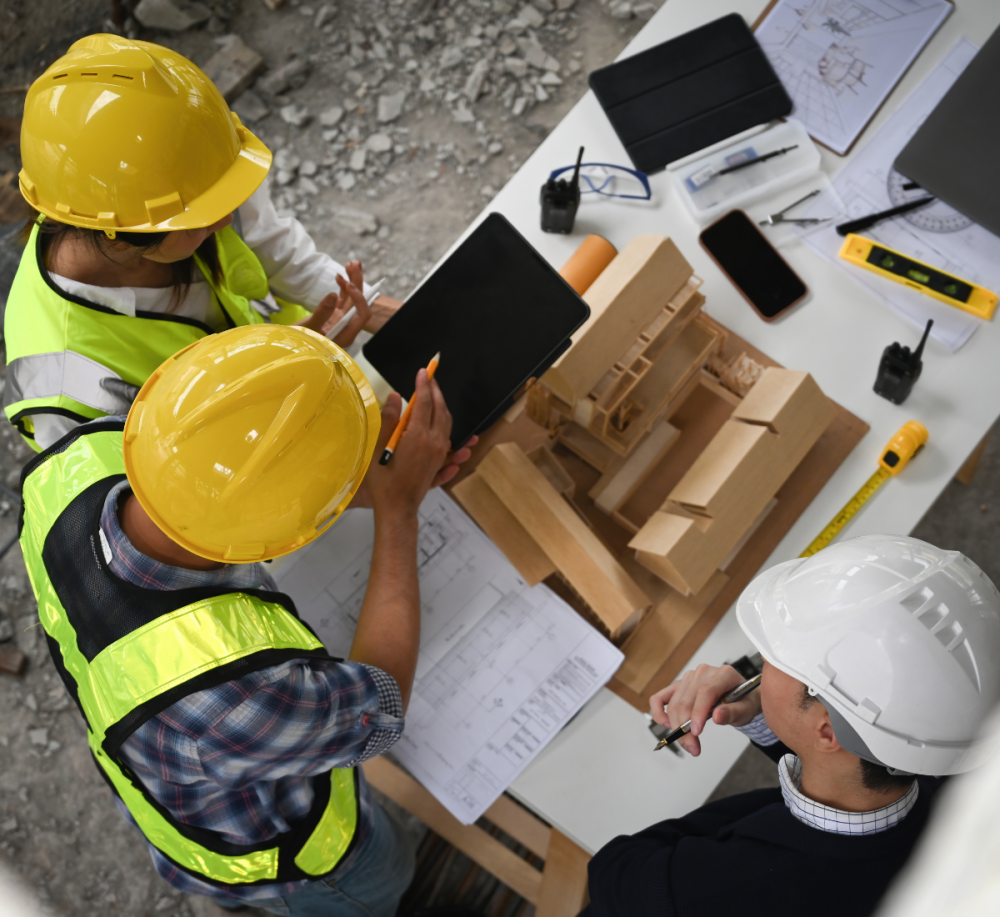

Building information modelling (BIM) consultancy
Our tailored approach ensures seamless BIM implementation, enhancing communication and efficiency, minimising errors, and ultimately saving time and money.
Streamlining BIM Workflows
BIM (Building Information Modelling) is the process of creating 2D or 3D digital simulations of buildings or infrastructure.
At Dexmah, our BIM consultants assist organisations in designing, implementing and optimising Building Information Modelling (BIM) processes throughout every phase of your project.
Our services include 2D and 3D modelling at each level, developing BIM strategies, providing training, managing data, and ensuring smooth collaboration across project teams.
Why choose us?

Expertise and experience
Dexmah's consultants bring years of experience in delivering tailored BIM consultancy services, ensuring your project is optimised for performance and meets industry standards.

Comprehensive support
From the planning and design phases to construction and facility management, we provide end-to-end support, ensuring smooth BIM implementation and integration at every stage.

Sector-specific approach
Whether residential, commercial, or industrial, we tailor our BIM strategies to meet the unique needs of your project, ensuring alignment with your goals and sustainability targets.

Proven results
Our clients benefit from improved workflows and streamlined delivery, reducing the need for future revisions and ensuring long-term satisfaction.

What are the BIM Levels ?
There are 6 BIM levels to suit different project requirements. Each level represents a step toward greater digital integration and efficiency in construction and asset management.
This is the most basic level, relying on 2D drawings. At this level, communication between teams is done through traditional, paper-based methods such as printed drawings and email. Most industries are now working above this level.
At this level, a mix of 2D and 3D design is used, and all models must follow British Standards (BS 1192), which helps keep everything well-organised and easy to share.
This level is highly collaborative, with everyone involved in the project being able to create their own BIM 3D models and share information. BIM Level 2 is mandatory for all public sector construction projects since April 2016.
BIM Level 3 is even more collaborative, allowing everyone to use a single, shared project model, called Open BIM.
Level 4 considers the broader social impact of construction projects, including community engagement, health and wellbeing of occupants, and the project’s environmental footprint.
Level 5 allows stakeholders to determine cost and manage budget throughout the project lifecycle and make real-time decisions. This transparency allows for better collaboration and enables teams to make more informed decisions.
Level 6 allows stakeholders to perform sustainability analysis before construction work even begins. This includes predicting energy consumption and making informed decisions about materials. Teams that adopt Level 6 benefit from reduced risks, waste and delays.
Key benefits of BIM
- BIM helps you reduce energy consumption and meet sustainability targets by analysing data like building orientation, thermal mass, and envelope leakage to identify areas for improvement.
- BIM enables real-time collaboration among all project stakeholders, which reduces communication errors and delays.
- By simulating construction processes, BIM helps identify issues early, leading to streamlined workflows and accurate cost estimates.
- Detailed simulations help identify safety hazards, improving quality control and ensuring compliance with standards.
- BIM provides digital records for effective maintenance, asset management, and performance evaluation post-construction.
Our step-by-step approach
Step 1: Pre-design phase
The BIM journey begins with a thorough understanding of the project’s objectives, requirements, and constraints. During the pre-design phase, we work with stakeholders to establish goals, budgets, and timelines. We then create initial BIM models to visualise the building and assess different design options, ensuring alignment with the client’s vision. This phase sets the foundation for the entire project.
Step 2: Design phase
In the design phase, we create a detailed simulation of the building. Our team use industry-leading software to integrate architectural, structural, and MEP (Mechanical, Electrical, and Plumbing) elements. Working closely with your project team, we perform clash detection, simulations, and construction sequencing to optimise the design.
Step 3: Construction phase
Once the design is finalised, the BIM model comes to life during construction. Our BIM models guide on-site construction processes, ensuring that building works align with the design specifications. BIM allows for better coordination and monitoring of progress, helping to identify potential issues before they arise. This phase significantly reduces the likelihood of costly delays, rework, and communication errors.
Step 4: Facility management phase
After project completion, our BIM models continue to provide value in the facility management phase. The digital model serves as a comprehensive record for ongoing building maintenance, renovations, and upgrades. Facility managers can access crucial information on building systems and maintenance schedules, ensuring that the building operates efficiently and sustainably.
Other Services
Building Data & Analytics
We use data and analytics to get a full understanding of what's going on in your building.
Design & Engineering Services
Minimise the environmental impact of your building whilst keeping occupants safe and comfortable.
Reports & Certifications
Minimise the environmental impact of your building whilst keeping occupants safe and comfortable.

FAQS
BIM helps with cost management by providing accurate estimations and simulations of materials and construction processes. With BIM, potential cost overruns can be identified early, and the project can be adjusted to stay within budget. It also reduces the need for expensive revisions and errors during construction.
BIM streamlines project delivery by providing a shared digital model that all team members can access. It allows for early detection of design issues, reduces the need for rework, enhances collaboration, and improves scheduling, all of which lead to faster and more efficient project completion.
Yes, BIM is not just for the design and construction phases. It can be used for facility management and maintenance after the building is complete. BIM models can store important data for ongoing maintenance, helping facility managers track the building’s performance, plan upgrades, and manage assets.
BIM is suitable for most construction projects, from small buildings to large infrastructure works. However, its complexity and benefits are most pronounced in larger, more complex projects where coordination between multiple disciplines is crucial.
The level of BIM you should adopt depends on the complexity of your project and your specific goals. Level 0 is suitable for simple projects with minimal collaboration, while higher levels (Level 2 and above) offer more detailed 3D modelling and enhanced collaboration for larger, more complex projects. Our team at Dexmah will help guide you through the decision-making process, assessing your project needs and recommending the most appropriate level of BIM to ensure optimal efficiency and results.
The cost of implementing BIM can vary widely depending on the size of the project and the technology used. The costs typically include software licenses, hardware upgrades, staff training, and potential consultancy services. However, the long-term savings from reduced errors, better project management, and higher-quality construction often outweigh the initial costs.
We offer comprehensive training services tailored to your team’s specific needs, helping you build the necessary skills to implement and optimise BIM effectively. Whether you’re new to BIM or looking to enhance your current skills, we provide step-by-step guidance, from basic concepts to advanced techniques, ensuring your team can manage projects more efficiently and make the most of BIM technology.
Get in touch for a free consultation on how we can help you with you project